You know that feeling. The meeting ends, everyone logs off, and you're left staring at a page of half-legible scribbles. Three bullet points, one mysterious arrow diagram, and the sinking realization you already forgot who was supposed to follow up on what. So you piece it together from memory, message three colleagues for confirmation, and somehow that "15-minute wrap-up" swallows another 45 minutes of your evening.
That quiet overtime—the kind nobody tracks but everyone feels—is where Tidenote actually earns its keep. It doesn't just transcribe your meetings. It finishes them for you.
What Tidenote Does Differently
Most AI note-takers dump a wall of text on you and call it a day. Tidenote tries something harder: it structures your chaos into something you'd actually share with a teammate who missed the call.
The core loop is simple. Hit record during a meeting, class, or research session. Tidenote handles the transcription in real time. When you're done, it generates a clean summary that pulls out decisions, action items, and key questions. Not a transcript nobody reads—a summary that actually saves the next scroll.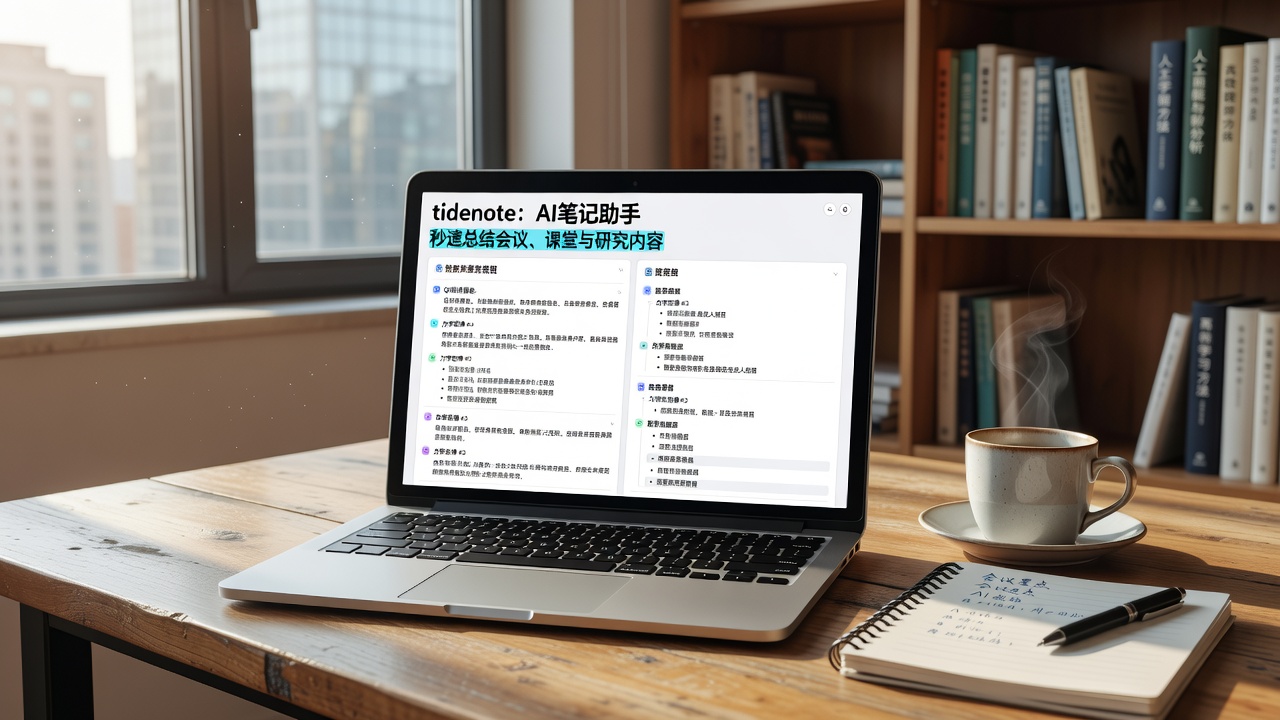
Three Scenarios Where It Cuts Real Time
The Long Client Call That Goes Everywhere
A 90-minute discovery session with a client who loves to talk. Half the useful information is buried in stories, tangents, and "one more thing" moments. With Tidenote, I let it run in the background, stayed present in the conversation, and after the call had a clean 2-minute summary with six action items. No rewatching the recording. No notes jenga. The next email draft took five minutes instead of forty.
The Lecture or Workshop You Want to Actually Pay Attention To
Everyone knows the dilemma: take detailed notes and miss half what's said, or listen actively and remember nothing. Tidenote turns that tradeoff into a non-issue. Let it transcribe, follow the lecture, then review a clean summary later. For research-heavy subjects, it's like having a teaching assistant who actually caught every example the professor mumbled.
The Brain-Dump Research Session
When you're reading across multiple sources and trying to connect ideas, stopping to take structured notes breaks your flow. I'll read, highlight, and dump raw thoughts into Tidenote. Later, I ask it to reorganize those fragments into a coherent outline. It's not a replacement for thinking—it's a replacement for the administrative overhead of thinking.
The Tradeoff Worth Knowing
Tidenote handles structured conversation well—meetings with clear segments, classes with slide transitions, interviews with Q&A rhythm. But if your recording is pure chaos—five people talking over each other for an hour with no agenda—the summary quality drops. You'll still get something usable, but you may need a quick pass to correct misattributed action items.
Also: it works best in English. Other languages are supported but the summary sharpness varies. If most of your material is in English, this is a no-brainer. If your workflow is heavily multilingual, test a few recordings before committing.
Who Should Try It
Anyone whose calendar is more meetings than deep work. Anyone who has ever said "I'll clean up my notes later" and felt that obligation drag across multiple weeks. And specifically, anyone in research, consulting, or client-facing roles where accuracy matters and memory isn't reliable enough.
It won't eliminate overtime entirely. But it will kill the hidden overtime—the 20 minutes after every meeting that you spend reconstructing what just happened. That alone makes it worth a download.
Comments
Leave a Comment